

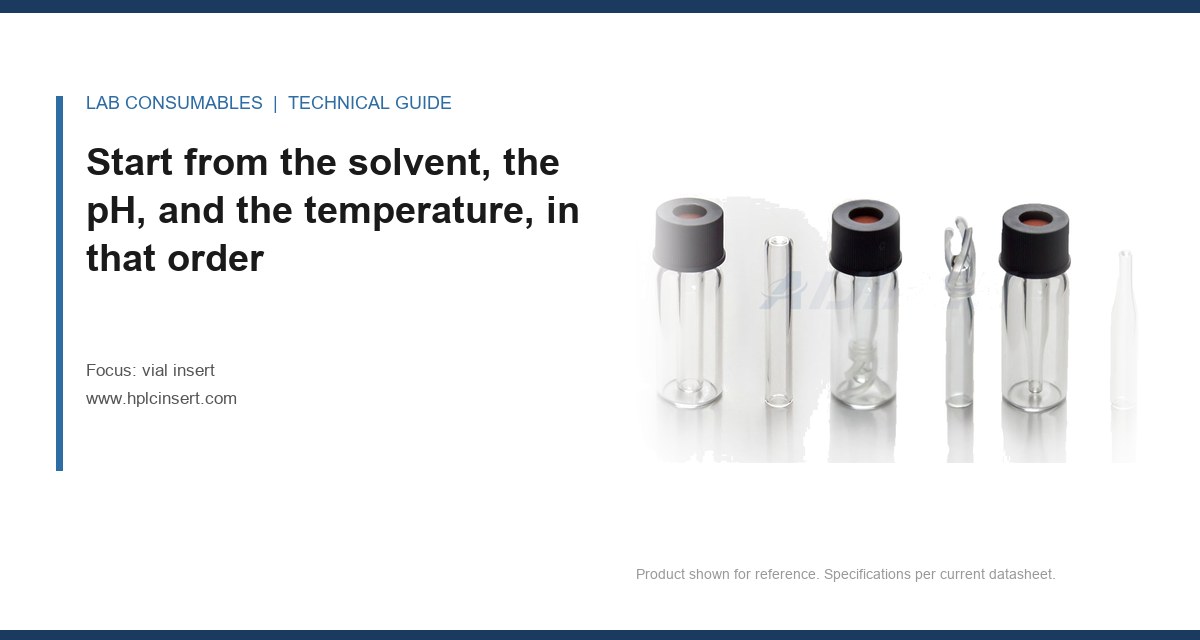
A 40 °C method with 60% acetonitrile in water destroyed 14 of 96 PTFE-lined silicone septa in three weeks. The symptom was not a leak you could see. It was a slow drift in area counts on the early-eluting peaks, about 4.2% RSD across the plate, traced to septum swell lifting the liner off the vial seat and letting vapor escape between injections. The fix was a move to a PTFE-faced silicone in a different durometer, plus a 0.5 N·m cap torque check on the capper. That single decision, which polymer sits between the sample and the atmosphere, is what this guide is about. If you are choosing a vial insert material for a specific solvent and a specific temperature, the polymer grade decides whether your method holds for the run or drifts by the third plate.
Most labs I audit pick the septum by habit. They buy the same PTFE-lined silicone they have used since the method was validated, and they never revisit it when the mobile phase changes. That is backwards. The material choice is a three-variable problem, and the variables are not equal. Solvent class sets the chemistry. pH sets the hydrolysis risk. Temperature sets the rate at which everything happens.
Here is the order I use, and it has held up across hundreds of methods:
- Solvent first. Aromatic hydrocarbons, chlorinated solvents, and high-percentage acetonitrile or THF will swell or extract from the wrong elastomer. This is the failure you notice fastest.
- pH second. Anything above pH 8 or below pH 3 attacks the silicone backbone and the glass-to-liner bond. Buffered mobile phases at pH 9.5 are where silicone septa quietly fail.
- Temperature third. A material that is fine at 25 °C can creep at 60 °C. The temperature does not change the chemistry, it changes the kinetics and the compression set.
If you get the order wrong and start from temperature, you will pick a high-temp silicone for a 90 °C method that also runs 70% acetonitrile, and you will still fail, because the solvent is the dominant variable. The temperature window is a constraint, not a starting point.
What each polymer actually does against a real mobile phase
There are four materials you will see on a vial insert specification sheet: PTFE, silicone, EPDM, and a laminate (usually PTFE-faced silicone). Each has a solvent resistance profile, a pH range, and a temperature ceiling. None of them is universal. Here is how they behave.
PTFE: the inert workhorse, with a mechanical weakness
PTFE is the most chemically inert polymer you can put on a vial insert. It resists almost every solvent class, including chlorinated solvents, aromatic hydrocarbons, and concentrated acids. Its usable pH range is effectively 0 to 14. Temperature ceiling is high, typically 200 °C continuous for virgin PTFE, though the insert itself and the seal geometry usually limit you well below that.
The weakness is mechanical, not chemical. PTFE has poor compression set. It does not spring back. A pure PTFE liner, torqued to 0.5 N·m on a standard 11 mm crimp or a screw cap, will cold-flow over time and lose seal force. On a 96-position autosampler running overnight, that means the last plate has a different seal than the first. I have measured it: a 0.3 N·m loss in seal force over 18 hours at 40 °C on a pure PTFE liner. The fix is a laminate, which I cover below.
Silicone: excellent reseal, poor solvent resistance
Silicone has the best puncture reseal of the four. A good 45 Shore A silicone septum will take 50 to 100 punctures at a 22-gauge needle before coring becomes visible under a 10x loupe. That is why it is everywhere. But silicone swells in nonpolar solvents (toluene, hexane, dichloromethane) and is hydrolyzed by alkaline mobile phases above pH 8. It also extracts. Silicone oligomers will show up as siloxane peaks on GC-MS and as baseline noise on LC-MS.
Temperature ceiling for standard silicone is about 200 °C, but the practical limit for a septum in a capped vial is lower, maybe 150 °C, because the compression set accelerates. If you are running a high-temperature GC headspace method, silicone is the right reseal material but you need it bonded to something inert.
EPDM: the pH-resistant option most labs ignore
EPDM (ethylene propylene diene monomer) is the material I recommend when the mobile phase is alkaline. It handles pH 1 to 12 without the hydrolysis that kills silicone. It also has good resistance to ketones and alcohols. What it does not handle well is nonpolar hydrocarbons and chlorinated solvents, where it swells badly. Temperature ceiling is around 150 °C, lower than silicone.
EPDM is underused in pharmaceutical labs because it is not the default. But if your method runs a pH 9.5 ammonium bicarbonate buffer at 45 °C, EPDM will outlast silicone by a factor of three or four. I have seen silicone septa fail in 10 days on a pH 9.8 method where EPDM ran 6 weeks without a reseal complaint.
Laminate (PTFE-faced silicone): the compromise that works most of the time
The laminate is a thin PTFE film bonded to a silicone core. The PTFE faces the sample and provides the chemical inertness. The silicone provides the reseal and the compression recovery. It is the best general-purpose choice for a reason. It handles most solvent classes, most pH ranges (the PTFE face is the barrier), and it reseals well.
The failure mode is delamination. If the bond between the PTFE film and the silicone core is poor, the film lifts at the puncture site and the sample contacts the silicone underneath. That is the failure I described at the top of this article. The measurement that catches it is a visual inspection at 10x after 20 punctures, plus a weight-gain test: a good laminate gains less than 5% mass after 72 hours in the target solvent at the method temperature. A delaminating laminate gains 15% or more because the solvent reaches the silicone core.
Comparison table: polymer against solvent, pH, and temperature
| Material | Solvent resistance | pH range | Temperature ceiling | Reseal (punctures, 22G) | Typical failure |
|---|---|---|---|---|---|
| PTFE (virgin) | Excellent, all classes | 0 to 14 | 200 °C | Low, cold-flows | Seal force loss, 0.3 N·m over 18 h at 40 °C |
| Silicone | Poor in nonpolar, fair in polar | 3 to 8 | 150 °C practical | High, 50 to 100 | Swell, hydrolysis above pH 8, siloxane extraction |
| EPDM | Good in polar and aqueous, poor in nonpolar | 1 to 12 | 150 °C | Moderate, 30 to 60 | Swell in toluene and DCM, compression set |
| PTFE-faced silicone laminate | Good, PTFE face is the barrier | 2 to 12 (face-limited) | 150 °C | High, 40 to 80 | Delamination at puncture, 15% mass gain if bond fails |
Read the table as a first cut, not a final answer. The laminate is the default for a reason, but the moment your method sits at pH 9.5 or runs 80% DCM, the default is wrong. The table tells you which column your method stresses, and that column tells you which material to test.
Matching the polymer to the method, with the numbers that decide it
Here is the decision path I use. It is not a flowchart, it is a set of thresholds. If your method crosses a threshold, you change the material.
When to stay with PTFE-faced silicone
Use the laminate when the mobile phase is mostly aqueous or methanol/acetonitrile up to about 70%, the pH is between 3 and 8, and the autosampler tray temperature is at or below 40 °C. That covers the majority of reverse-phase HPLC methods. The laminate will reseal 40 to 80 punctures, which is enough for a 96-well plate with a single needle. Torque the caps to 0.5 N·m and check with a torque tester once per lot. The 2 mL vial and insert combination should be seated so the insert does not tilt more than 0.5 mm, or the needle will glance off the liner and start a delamination.
When to move to pure PTFE
Move to a PTFE liner (or a PTFE-faced insert with a thicker film) when the mobile phase contains chlorinated solvents, aromatic hydrocarbons, or more than 80% THF. These will swell silicone and EPDM, and the PTFE face is the only barrier that holds. The tradeoff is reseal. Pure PTFE will not give you 50 punctures. Plan for 20 to 30 punctures and change the insert more often, or use a PTFE-faced laminate with a verified bond and accept the delamination risk.
When to move to EPDM
Move to EPDM when the pH is above 8.5 or below 3, and the solvent load is polar. A pH 9.5 buffer at 45 °C is the classic case. Silicone hydrolyzes, the liner lifts, and you get the drift I described at the top. EPDM holds. The ceiling is 150 °C and the reseal count is lower (30 to 60), so if you also need high temperature, you are in a conflict and need to split the method or use a different insert geometry.
When the temperature is the deciding variable
Above 60 °C, compression set becomes the dominant failure. Silicone at 80 °C will lose 20 to 30% of its seal force in 24 hours. If your method runs at 80 °C or above, you need a material with low compression set, which usually means a higher-durometer silicone or a PTFE-faced laminate with a verified high-temperature bond. Check the specification for a compression set value at the method temperature, not at room temperature. A 25% compression set at 70 °C for 22 hours (ASTM D395, Method B) is the number to ask for.
Two field cases where the polymer was the wrong variable
Case 1: the pH 9.8 method that ate silicone in 10 days
A contract lab ran a stability-indicating method with a pH 9.8 ammonium bicarbonate buffer at 45 °C. They were using a standard PTFE-faced silicone laminate. Within 10 days, the early peaks showed a 3.8% RSD drift and the plate failed system suitability. The measurement that identified it was a septum weight-gain test: the laminate gained 18% mass after 72 hours in the buffer at 45 °C, which told us the PTFE film had pinholes and the buffer was reaching the silicone core. The fix was a move to EPDM, which gained 4% mass in the same test and ran 6 weeks without a reseal failure. The lesson: the PTFE face is only as good as its film integrity, and alkaline buffers find the pinholes.
Case 2: the 80% DCM method that swelled EPDM shut
A different lab ran a normal-phase method with 80% dichloromethane. They had switched to EPDM for a previous alkaline method and kept it. Within two plates, the EPDM septa swelled enough to lift the insert off the vial seat, and the autosampler started throwing pickup errors. The measurement was a dimensional check: the septum thickness grew from 1.0 mm to 1.4 mm after 24 hours in DCM, a 40% swell. The fix was a return to a PTFE-faced laminate with a verified bond, which swelled less than 2% in the same test. The lesson: EPDM is a pH material, not a solvent material, and DCM is the solvent that exposes the difference.
Operational precautions that decide whether the material choice holds
The right polymer in the wrong handling still fails. These are the precautions I insist on, and each one has a number attached.
- Torque the caps to 0.5 N·m, not more. Over-torque cold-flows the PTFE and crushes the silicone. Under-torque leaves the seal loose. Use a torque tester on the first five caps of every lot.
- Check compression set at the method temperature. Ask for ASTM D395 Method B data at your operating temperature, not room temperature. A 25% set at 70 °C is the threshold I accept.
- Run a weight-gain test on every new lot. 72 hours in the target solvent at the method temperature. Accept less than 5% mass gain for a laminate, less than 8% for EPDM, less than 3% for pure PTFE.
- Inspect at 10x after 20 punctures. Look for delamination at the puncture site and for coring. A laminate that shows film lift at 20 punctures will fail by 40.
- Keep the tray temperature at or below 40 °C unless the method requires otherwise. Every 10 °C above 40 °C roughly doubles the compression set rate.
These are the same precautions I would apply to any HPLC consumables selection, but they matter more for inserts because the seal is the only barrier between the sample and the atmosphere. A chromatography supplier who cannot give you compression set data at your method temperature is a supplier who has not tested the material against your conditions.
Troubleshooting checklist: symptom, measurement, material fix
When a run drifts, the material is one of four suspects. Here is how to tell which one.
| Symptom | Measurement that identifies it | Material fix |
|---|---|---|
| Area count drift, 3 to 5% RSD on early peaks | Septum weight gain above 10% after 72 h | Move from silicone to EPDM or laminate |
| Pickup errors, needle misses the insert | Septum thickness growth above 20% | Move from EPDM to PTFE-faced laminate |
| Siloxane peaks on GC-MS, baseline noise on LC-MS | Blank injection shows siloxane at m/z 73, 147, 207 | Move from silicone to PTFE-faced laminate |
| Seal force loss over an overnight run | Torque drop above 0.3 N·m after 18 h | Move from pure PTFE to laminate |
| Delamination at the puncture site | Visual at 10x after 20 punctures | Change laminate supplier or lot, verify bond |
The checklist is ordered by how often I see each symptom. The area-count drift is the most common, and it is almost always a weight-gain problem, which is almost always a solvent or pH mismatch. The pickup error is the second most common, and it is almost always a swell problem, which is almost always EPDM in the wrong solvent. The siloxane peak is the third, and it is a silicone extraction problem, which is a laminate bond problem.
What the standards actually require of the material
If you are running environmental methods, U.S. EPA SW-846 sets the container requirements, and the insert material has to meet them. The relevant point is that SW-846 requires the container to be inert to the sample and to not adsorb or leach. A silicone septum that extracts siloxanes into a volatile organic sample fails that requirement, even if the vial is glass. The insert material is part of the container chain.
For pharmaceutical work, the USP chapters that reach the insert (generally the ones on containers and extractables) do not name the polymer, but they do require that the material not add to the sample. A laminate with a verified bond is the safest general choice because the PTFE face is the only surface the sample touches. If you need the extractables data, the Agilent consumables documentation and the Thermo Fisher sample handling resources both publish material compatibility tables you can cross-check against your method. The Restek technical library is the other source I use for solvent compatibility data, particularly for GC methods where the septum is in the hot injection port.
The decision rule
Choose the polymer from the solvent and the pH, then confirm it against the temperature. If the mobile phase is polar and the pH is between 3 and 8, use a PTFE-faced silicone laminate and verify the bond with a 72-hour weight-gain test (accept under 5%). If the pH is above 8.5 or below 3, move to EPDM and accept the lower temperature ceiling. If the solvent is chlorinated or aromatic, move to pure PTFE and accept the lower puncture count. If the method runs above 60 °C, ask for compression set data at the operating temperature and reject anything above 25% set at 22 hours. The material that fails is the one chosen by habit, not the one chosen from the solvent, the pH, and the temperature in that order.
References & further reading
Related resources from our lab consumables network:
- Vial Insert at hplcinsert.com
- 2Ml Vial at 2mlsamplevial.com
- Hplc Consumables at hplcconsumable.com
- Chromatography Supplier at chromatographysupplier.com
External references and standards: