

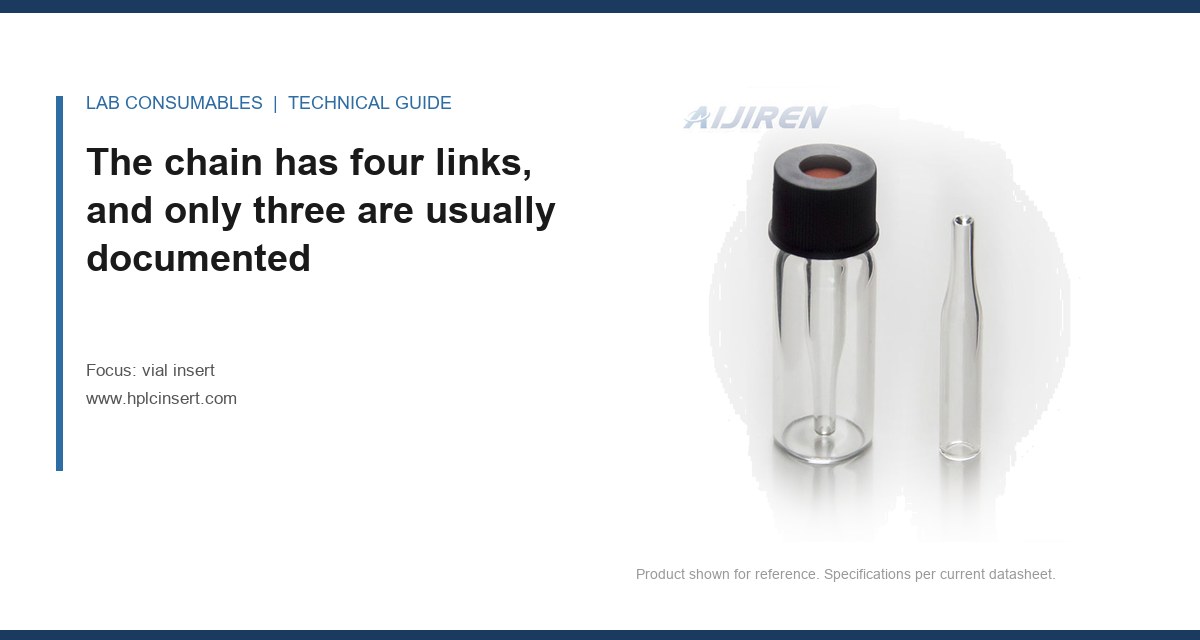
A lab I work with failed an ISO 17025 surveillance assessment in March over a box of 300 µL glass inserts. Not the instrument, not the method, not the analyst. The assessor asked one question: “Show me the certificate of analysis for the glass lot in this drawer, and show me that the lot on the certificate is the lot in the drawer.” The lab had a CoA. It was for a different lot number. The purchasing clerk had filed it against the PO, not the delivery. That single broken link cost them a finding and a 90-day corrective action cycle. This article is about that chain, specifically for vial inserts, and where it usually snaps.
ISO 17025 traceability for a vial insert is not the same problem as traceability for a reference standard or a balance calibration. Those are addressed in ISO/IEC 17025:2017 clause 6.5 with a fairly clean metrological logic. A consumable is different. It is a physical part that touches the sample, and the standard’s traceability requirement reaches it through the sample integrity argument, not through a calibration chain. Most labs can produce two of the three links. The third one, the one that connects the physical part in the autosampler to the documentation on file, is where the chain breaks in about four out of five audits I have sat through.
An unbroken traceability chain for a vial insert runs from the raw glass to the physical insert sitting in the tray. I count four links.
- Link 1: raw material to forming lot. Glass tubing lot, drawn from a specific furnace charge, with dimensional and chemical data.
- Link 2: forming lot to finished part. The drawn tube is cut, fire-polished, and annealed. This is where the critical dimensions (outer diameter, length, wall, bottom thickness) are set, and where the certificate of analysis should attach.
- Link 3: finished part to packaging lot. Inserts are bagged, boxed, labeled. The label carries a lot code that ties back to the forming lot.
- Link 4: packaging lot to the physical insert in the autosampler. The receiving record, the drawer label, and the insert itself all agree on the same lot code.
Links 1, 2, and 3 are the supplier’s job, and a competent supplier produces all three on request. Link 4 is the lab’s job. Link 4 is the one that breaks.
What the standard actually asks of a consumable
Clause 6.5 of ISO/IEC 17025:2017 requires metrological traceability for “measurement results.” It does not name consumables. A vial insert is not a measuring device. So how does the requirement land on a piece of glass?
It lands through clause 7.3 (sampling) and clause 7.4 (handling of test items). If the insert can affect the measurement result (and it can, through adsorption, extractables, and geometry-driven pickup), then the lab has to demonstrate that the insert used in a given run was the insert on file. That is a traceability argument, even if the standard does not use the word “consumable.”
In practice, an assessor will ask three questions:
- Can you show the specification the insert was purchased against?
- Can you show the certificate or inspection data that confirms the delivered insert met that specification?
- Can you show that the insert in the autosampler today is from that delivered lot?
Questions 1 and 2 are usually answerable. Question 3 is the one that produces findings. The reason is structural: the insert is a small, unlabeled, disposable part. Once it is out of the bag and into the tray, it has no identity. The lot code lives on the bag, and the bag goes in the trash the day the tray is loaded.
Why this is different from a reference standard
A reference standard has a certificate with a stated uncertainty and a defined expiry. The traceability chain is metrological, and the lab is expected to hold the certificate and the standard together. A vial insert has a certificate of analysis with dimensional and chemical data, but no uncertainty statement, because the insert is not a measurement. The traceability chain is documentary, not metrological, and the lab is expected to hold the delivery record and the physical part together. Those are different disciplines. Labs that are strong on the first are often weak on the second, because the second is a warehouse problem disguised as a quality problem.
Link 4 is the one most labs cannot produce, and here is why
I have walked into more than thirty labs to look at this specific question. The pattern is consistent. The purchasing system holds the PO. The receiving system holds a packing slip. The quality system holds a CoA, usually filed by supplier and date. None of these three systems is keyed to the lot code on the box. So when the assessor asks “which lot is in the autosampler right now,” the lab has to physically walk to the drawer, read the label on the bag, and hope the bag is still there.
Often it is not. The bag was opened three weeks ago, the inserts were poured into a secondary container, and the secondary container has no label. The lot is now unknown. The chain is broken at the last link, and the first three links do not help.
This is not a paperwork failure. It is a physical handling failure. The fix is operational, not administrative.
Field case: the drawer that lost its label
A pharmaceutical QC lab running USP <621> assays on a 2 mL vial format (2 mL vial with a 250 µL pulled-point insert) had a run-to-run RSD drift from 0.4% to 1.1% over two weeks. The method had not changed. The instrument had been PM’d. The analyst was the same. What changed was the insert lot. The lab had received a new shipment, poured the new inserts into the same drawer as the old ones, and the two lots were now mixed. The old lot had a bottom thickness of 1.1 mm nominal; the new lot was 1.3 mm. Both met the drawing tolerance. Neither was wrong. But the pickup volume shifted by about 8 µL because the needle depth relative to the bottom changed.
The measurement that identified it: the lab ran a gravimetric check on ten inserts from each lot, weighing the delivered volume at a fixed 10 µL draw. The two populations were distinguishable at p < 0.01. The fix was a labeled secondary container per lot, a physical separation rule, and a receiving procedure that writes the lot code on the secondary container at the moment of transfer. The lot-to-lot drift did not recur, because the lab could now see the lot change before the run, not after.
What a certificate of analysis for an insert should contain
A CoA that supports traceability has to carry the lot code, the drawing revision, and the inspection data that ties the two. If any of those three is missing, the certificate is decorative.
| Field | What it must contain | Why it matters for traceability |
|---|---|---|
| Lot code | Alphanumeric, unique to the forming and packaging run | This is the key that links the physical part to the document |
| Drawing revision | Revision letter or number, with issue date | Confirms the part was made to the current specification |
| Outer diameter | Measured value with tolerance (e.g., 6.00 ± 0.10 mm) | Fits the 2 mL vial bore; out-of-tolerance causes tilt and pickup error |
| Length | Measured value with tolerance (e.g., 31.0 ± 0.5 mm) | Sets the needle depth relative to the vial bottom |
| Bottom thickness | Measured value with tolerance (e.g., 1.2 ± 0.15 mm) | Directly affects pickup volume and needle contact |
| Glass type | e.g., USP Type I borosilicate, hydrolytic class | Chemical inertness; extractables risk |
| Annealing / strain | Pass/fail against a stated test (e.g., polariscope) | Residual stress causes cracking during autosampler handling |
| Extractables (if claimed) | Method and result (e.g., <0.5 µg/mL at 40 °C, 24 h) | Supports the sample integrity argument |
| Inspection sampling | AQL level and sample size (e.g., 1.0 AQL, n=32) | Confirms the data is statistically meaningful, not a single-part check |
I have seen CoAs that list every field above and CoAs that list three. The difference is usually not the price of the insert. It is whether the supplier has a documented inspection plan or just a drawing. When you are choosing a chromatography supplier, ask for a sample CoA before you ask for a quote. If the CoA does not carry a lot code and a drawing revision, the traceability chain cannot be closed, regardless of what the price list says.
The receiving step is where the chain is won or lost
Most labs treat receiving as a counting exercise. Count the boxes, sign the slip, put them on the shelf. That is the step that breaks link 4. A receiving procedure that supports traceability has four elements, and none of them take more than a few minutes per shipment.
Step 1: match the lot code on the box to the lot code on the CoA
Not the PO. Not the packing slip. The CoA and the box label. If they do not match, the shipment is quarantined and the supplier is contacted. This is the single highest-yield check in the whole procedure, and it is the one most labs skip.
Step 2: write the lot code on the secondary container at the moment of transfer
The bag will be opened and discarded. The secondary container (a labeled drawer, a labeled bin, a labeled jar) becomes the identity carrier. Write the lot code, the receipt date, and the drawing revision on the label before the first insert leaves the bag. This is the physical fix for the drawer-label failure above.
Step 3: hold a reference sample from each lot
Ten to twenty inserts, sealed in the original bag, labeled with the lot code, stored in a cabinet. When a drift event happens, you have a physical comparator. Without it, you are arguing from memory. With it, you can run a side-by-side gravimetric or dimensional check and settle the question in an afternoon.
Step 4: record the lot code in the run record
The analyst records the insert lot code in the run record or the LIMS entry, the same way they record the column serial number. This is the link that lets you answer the assessor’s question without walking to the drawer. It is a five-second entry per run batch, and it is the difference between a closed chain and a finding.
Which link breaks in each of the three common lab setups
The failure mode depends on how the lab is organized. I have seen three patterns, and each has a predictable weak point.
| Lab setup | Weak link | Typical symptom | Fix |
|---|---|---|---|
| Central purchasing, distributed use | Link 4 (physical part to record) | Lot code lost at transfer; drawer unlabeled | Secondary container labeling at receipt |
| Single analytical group, one bench | Link 2 (forming lot to CoA) | CoA is generic, no lot code, no drawing revision | Supplier qualification: require lot-specific CoA |
| Contract lab, multi-client | Link 3 (finished part to packaging lot) | Same insert type from two suppliers mixed in one bin | Physical segregation by supplier and lot |
The contract lab pattern is the worst, because the client’s method may specify an insert type but not a supplier, and the lab may have two suppliers’ parts in the same bin. Both meet the drawing. Neither is wrong. But the traceability chain now has two possible paths, and the lab cannot say which one was used on which client’s samples. That is a finding waiting to happen.
Field case: the contract lab with two suppliers
A contract lab running EPA SW-846 methods (SW-846 8270 for semivolatiles) had a client complaint about a 12% low bias on a mid-level calibration standard. The method was fine. The instrument was fine. The inserts were from two suppliers, both 250 µL pulled-point, both meeting the drawing, and both in the same bin. One supplier’s inserts had a bottom thickness of 1.0 mm; the other’s was 1.3 mm. The autosampler needle depth was set for the 1.0 mm part. On the 1.3 mm part, the needle did not reach the liquid at low volumes, and the injection volume was short.
The measurement that identified it: the lab ran a dye-dilution check on ten inserts from each supplier, drawing 5 µL from a 100 µL fill. The 1.3 mm parts delivered 4.1 µL on average; the 1.0 mm parts delivered 5.0 µL. The fix was physical segregation by supplier in labeled bins, plus a drawing-revision check at receiving that caught the bottom-thickness difference before the parts hit the bench. The client complaint was resolved, and the lab added a supplier-code field to the run record so the question could be answered without a bench investigation.
What to ask a supplier before you accept the chain
Supplier qualification for a vial insert is not the same as for an instrument. You are not buying a calibration. You are buying a documented part. The questions that matter:
- Do you issue a lot-specific CoA with a drawing revision and inspection data? (If the answer is “we can provide a generic certificate,” the chain is broken at link 2.)
- What is the inspection sampling plan, and at what AQL? (1.0 AQL at n=32 is a reasonable starting point for dimensional data.)
- What is the drawing revision control process, and how do you notify customers of a revision change? (A revision change without notification is a silent lot change.)
- Can you provide a reference sample from the lot on request? (This supports link 3 and gives you a physical comparator.)
- What is the glass type and the annealing verification method? (USP Type I borosilicate with a polariscope strain check is the baseline.)
I have found that the suppliers who can answer all five in a single email are the ones whose CoAs are worth filing. The ones who answer three and promise the rest are the ones whose CoAs end up in the wrong folder. If you are evaluating a new source, look at their HPLC consumables documentation package before you place the first order. The documentation is the product, as far as traceability is concerned.
How to test your own chain in an afternoon
You do not need an audit to find the break. Run this check on your own bench.
- Pick a current insert lot in use. Ask the analyst to show you the CoA for that lot. Time how long it takes. If it takes more than five minutes, link 4 is weak.
- Ask the analyst to show you the physical bag or secondary container with the lot code. If it is unlabeled or the bag is gone, link 4 is broken.
- Check the CoA for a lot code and a drawing revision. If either is missing, link 2 is broken.
- Check the receiving record for a lot-code match between the box and the CoA. If the record only shows a PO and a quantity, link 3 is broken.
- Check the run record for an insert lot code entry. If it is not there, you cannot close the chain even if the first four are clean.
Most labs fail at step 2 and step 5. Step 2 is a physical labeling fix. Step 5 is a LIMS or run-record fix. Both are cheap. Neither requires a new supplier or a new instrument.
The decision rule
If you cannot answer “which insert lot was in the autosampler for this run” in under five minutes, using only records and a labeled container, your ISO 17025 traceability chain for vial inserts is broken, and the break is at the physical-to-documentary link. Fix that link first: label the secondary container at receipt, hold a reference sample per lot, and record the lot code in the run record. The supplier’s CoA matters, and you should require a lot-specific one with a drawing revision, but a perfect CoA does not close a chain that the lab breaks at the drawer. The part that touches the sample is the part the assessor will ask about, and it is the part most labs cannot name.
References & further reading
Related resources from our lab consumables network:
- Vial Insert at hplcinsert.com
- 2Ml Vial at 2mlsamplevial.com
- Hplc Consumables at hplcconsumable.com
- Chromatography Supplier at chromatographysupplier.com
External references and standards: