

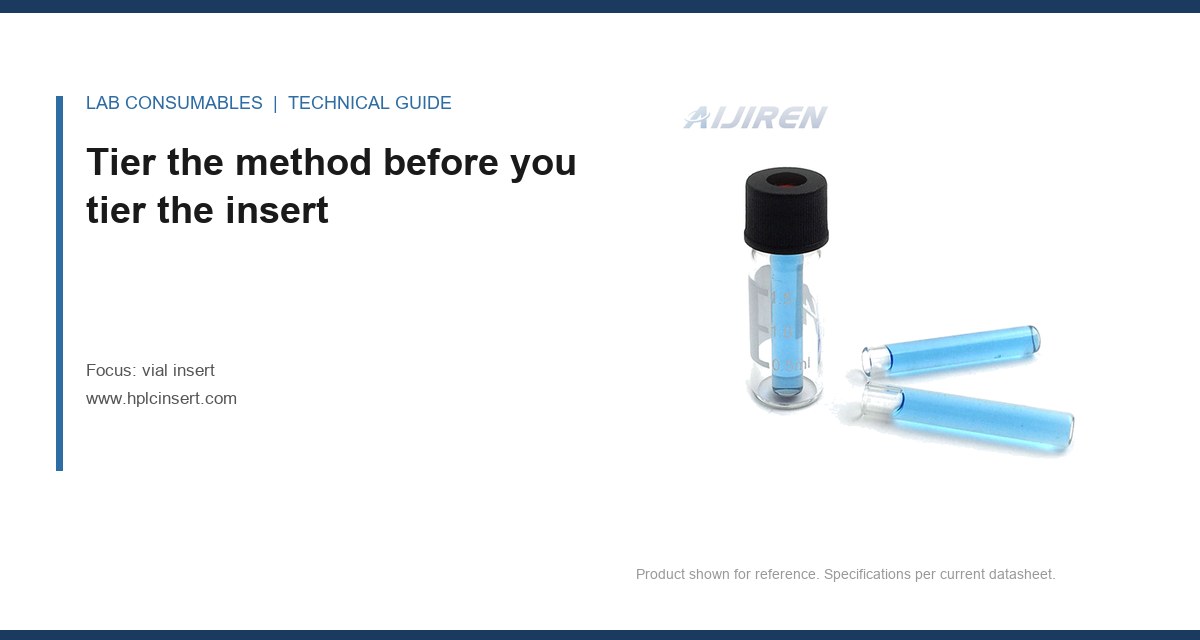
A 96-position run on a Waters 2695 came back with 14 injections flagged for internal standard RSD above 8%, all clustered in positions 61 through 74. The method used 250 µL glass inserts in a 2 mL vial, and the analyst had switched to a lower-priced lot six weeks earlier to trim consumable spend by about $0.04 per insert. The failure cost was a full re-prep of 96 samples, roughly 11 hours of instrument time, and a two-day delay on a release. That is the question this page answers: whether a low-cost vial insert is safe for a given method criticality, and where the savings stop being a saving.
I have bought inserts at $0.09 and at $0.42, and I have watched both fail. The difference is not the price tag. It is whether the insert’s tolerance band, glass chemistry, and dimensional consistency sit inside what your method and your sampler can absorb. Tier your consumables by method criticality first. Then let the failure cost decide what you pay. Everything below is that argument, with the numbers.
Most labs buy inserts by volume: one SKU for everything, negotiated once a year. That is the wrong axis. The right axis is what a single out-of-spec result costs you, because that number sets the ceiling on what you can rationally pay per insert.
I use four tiers. They are not official, but they map cleanly onto how labs actually staff and schedule work.
| Tier | Typical method | Consequence of one bad insert | Rational insert spend ceiling |
|---|---|---|---|
| Tier 1: screening | Presence/absence, high-limit QC, teaching runs | Re-inject, 10 minutes | Lowest-cost qualified insert |
| Tier 2: routine quant | In-process assay, ±5% spec | Re-prep a batch, 2-4 hours | Mid-tier, documented lot traceability |
| Tier 3: regulated release | Stability, dissolution, method-transfer | Invalid run, deviation, 1-3 days | Premium, CoA with dimensional data |
| Tier 4: forensic / legal | EPA SW-846, litigation, reference standards | Chain-of-custody break, inadmissible data | Highest, full traceability to lot and process |
Notice that the ceiling is not a price. It is a ratio. If a Tier 3 failure costs you $1,800 in labor and instrument time, then paying an extra $0.30 per insert across a 500-insert run costs $150. The math is not close. The problem is that most procurement decisions never see the $1,800, because it lands on a different cost center than the purchase order. That is the whole trap.
What a low-cost insert actually gives up
Cheap inserts are not cheap because someone is cutting corners illegally. They are cheap because a few specific things are relaxed, and you need to know which ones your method can tolerate.
Dimensional tolerance on the outer diameter
A standard 250 µL insert for a 2 mL vial runs about 5.0 mm OD at the body and 6.0 mm at the flange, with a length near 31 mm. Premium lots hold OD to ±0.1 mm. Budget lots often run ±0.25 mm or wider. On a fixed-position autosampler needle, 0.15 mm of extra OD is enough to change where the needle tip lands relative to the bottom taper, and that changes the residual volume the needle can reach. If your method injects 10 µL from a 250 µL insert, a 15 µL shift in reachable volume is a 6% change in the effective sample pool. That shows up as drift, not as a hard error, which is worse.
Glass chemistry and the bottom geometry
Borosilicate 3.3 and 5.1 are not the same on a pH 12 method or a 60 °C stability run. Cheap inserts sometimes use 5.1 or a mixed batch. The bottom taper also varies: a “conical” bottom can be a true cone or a rounded cup, and the difference changes the last 5 µL. If your method’s lower limit of quantitation depends on recovering that last fraction, a rounded cup will quietly cost you sensitivity.
Lot-to-lot consistency
This is the one that bites hardest, and it is invisible on the invoice. A budget supplier may run multiple forming tools across a year. A premium supplier typically locks one tool and one annealing profile per SKU. The practical test is not a single CoA. It is whether three consecutive lots give you the same needle-reach volume within ±2%. If they do not, you have a Tier 1 insert whether you paid for Tier 3 or not.
The failure cost that justifies paying more
Here is the number that changes buying behavior. I ask lab managers to write down three figures for their worst recent insert-related failure: analyst hours to re-prep, instrument hours lost, and the cost of the delayed result (release delay, re-run fee, client penalty). Then divide by the number of inserts in the affected run.
A typical Tier 3 failure: 4 analyst hours at a loaded rate, 8 instrument hours, one day of release delay. Call it $1,600 across a 96-insert run. That is $16.67 per insert in failure cost. If the premium insert costs $0.30 more and reduces the failure probability from, say, 3% to 0.5%, the expected cost of the cheap insert is 0.03 × $16.67 = $0.50 per insert, versus $0.30 for the upgrade. The premium wins on expected value even before you count the reputational cost of a deviation.
Run that same calculation on a Tier 1 screening method and the premium loses every time, because the failure cost is ten minutes of re-injection. That is the decision rule in one sentence: pay for the insert when the per-insert failure cost exceeds the price delta divided by the failure-rate reduction. For most regulated labs, that threshold is crossed somewhere around Tier 2.5.
Three field cases where the cheap insert was the right call
I want to be fair to the budget insert. It is often correct, and I have specified it deliberately.
Case 1: high-throughput screening with a wide spec
A contract lab running 1,200 samples a week on a presence/absence pesticide screen had been buying a $0.38 insert on habit. The spec was ±20% on a single analyte, and the autosampler was a fixed-needle design with generous clearance. We switched to a $0.11 insert from a supplier with a documented ±0.2 mm OD band. Over 12 weeks, zero re-injections traced to insert geometry. Annual saving: roughly $16,800. The measurement that justified it was the fixed-needle clearance, which was 0.8 mm, four times the tolerance band. That margin is what made the cheap insert safe.
Case 2: single-use method with no re-injection
A method-development group ran one-off exploratory gradients where every injection was unique and nothing was reported against a spec. Insert quality was irrelevant as long as the glass did not shed particles. They bought the cheapest qualified lot and disposed of it after one use. The failure cost was literally zero because there was no release decision attached. Cheap was correct.
Three field cases where it was a false economy
Case 3: the lot that drifted 0.3 mm
The opening scene, in detail. The symptom was rising internal-standard RSD clustered in the back third of the tray. The measurement that identified it: we pulled 30 inserts from the suspect lot and measured OD at the flange with a calibrated micrometer. Mean was 6.28 mm against a nominal 6.00 mm, with a range of 6.12 to 6.41 mm. The previous lot ran 6.01 to 6.09 mm. The sampler’s needle guide was sized for 6.0 mm nominal, and the oversized inserts were canting slightly in the tray, shifting the needle path. The fix was a lot quarantine, a return, and a switch to a supplier who publishes a dimensional capability (Cpk) number rather than a single-point CoA. Cost of the lesson: about $2,400, against a saving of $3.84 on the original purchase order.
Case 4: the pH 12 method that etched
A stability lab ran a high-pH buffer through a budget insert lot for a 72-hour hold. The symptom was a slow rise in a late-eluting peak area over the run. The measurement: inductively coupled plasma analysis of the held solution showed sodium and boron leaching above the method’s blank tolerance, consistent with a soda-lime or 5.1 glass rather than the 3.3 borosilicate the premium insert specified. The fix was a switch back to a 3.3 borosilicate insert with a documented hydrolytic resistance class. The cheap insert had saved $0.22 per unit and cost a three-day investigation.
Case 5: the coring that ate a needle
A lab running a septum-piercing autosampler with a 22-gauge needle noticed a rising injection-to-injection area RSD and, eventually, a bent needle. The symptom looked like a sampler problem. The measurement: we counted punctures on the septa and found the budget insert’s cap septum was thinner and softer than spec, so it deformed into the needle path after about 40 punctures instead of the rated 100-plus. The needle was coring the septum and dragging fragments. The fix was a septum with a documented puncture rating and a PTFE-faced liner. The insert itself was fine; the cap that came bundled with it was not. That is the hidden cost of a bundled cheap kit.
A decision checklist you can run before the next PO
This is the checklist I hand to procurement. It takes about 20 minutes and prevents most of the failures above.
- Method tier: assign Tier 1-4. If Tier 3 or 4, stop and specify a premium insert with a dimensional CoA.
- Autosampler clearance: measure the needle-guide clearance. If it is less than 3× the insert’s OD tolerance band, the cheap insert is not safe.
- Injection volume vs. reachable volume: calculate the residual volume the needle can reach in the cheap insert. If it is within 20% of your injection volume, you are at risk of drift.
- Solvent and pH: if pH is above 9 or below 3, or the hold exceeds 24 hours, require 3.3 borosilicate with a hydrolytic resistance class.
- Temperature: if the method holds above 40 °C, verify the insert’s rated maximum (most borosilicate is fine to 120 °C, but caps and septa are not).
- Puncture rating: if the sampler re-pierces, require a septum rated for at least 100 punctures, and check the bundled cap, not just the insert.
- Lot consistency: request three consecutive lots’ dimensional data. If the supplier cannot provide it, treat the insert as Tier 1 only.
- Failure cost: compute per-insert failure cost. Compare against the price delta. Decide.
That last line is the whole method. The rest is data collection.
Where the standards actually bind, and where they do not
No USP chapter names the insert directly. What binds is the method’s system suitability criteria and, for environmental work, the container requirements in EPA SW-846. If your method has an RSD limit of 2.0% on five replicate injections, the insert’s lot-to-lot consistency is part of what makes that limit achievable. If your method has no such limit (Tier 1), the standard does not care, and neither should you. The binding is method-specific, which is exactly why a blanket “buy premium” rule is as wrong as a blanket “buy cheap” rule.
For dimensional and material reference, the vendor technical libraries are more useful than the compendia. Agilent’s consumables documentation publishes OD and length tolerances for its insert families, and Thermo Fisher’s sample-handling pages list septum puncture ratings and glass classes. Restek’s technical resources are good on the pH and temperature limits of glass chemistries. Use these to write your own acceptance criteria, not to pick a brand.
Matching the insert to the rest of the consumable chain
An insert is one part of a stack: vial, cap, septum, insert, needle. The cheap-insert decision is only safe if the rest of the stack is stable. If you are buying budget inserts, buy them alongside a 2 mL vial and cap system from the same qualified supplier so the dimensional stack is consistent. Mixing a budget insert into a premium vial and cap assembly is where most of my field failures came from, because the tolerances were never designed to meet in the middle.
If you are sourcing across multiple SKUs, it helps to work with a HPLC consumables supplier who can give you lot-level dimensional data for the whole stack, not just the insert. And when you are ready to specify, start from the vial insert page and work outward to the vial and cap. A chromatography supplier who cannot give you a Cpk number on OD is telling you something: treat that insert as Tier 1 and price it accordingly.
The decision rule
Buy the cheapest insert whose dimensional tolerance band sits inside your autosampler clearance and whose glass chemistry survives your solvent, pH, and hold time. Then check whether the per-insert failure cost, multiplied by the failure-rate difference between the cheap and premium lots, exceeds the price delta. If it does, buy premium. If it does not, buy cheap and stop apologizing for it. The insert is not the place to demonstrate frugality or rigor. It is the place to match a tolerance band to a method tier, and to know which tier you are actually running.
References & further reading
Related resources from our lab consumables network:
- Vial Insert at hplcinsert.com
- 2Ml Vial at 2mlsamplevial.com
- Hplc Consumables at hplcconsumable.com
- Chromatography Supplier at chromatographysupplier.com
External references and standards: